Research
Working papers and publications in game theory, mechanism design, and international economics.

Research
Barcelona, where I completed my PhD
Published & Accepted
-
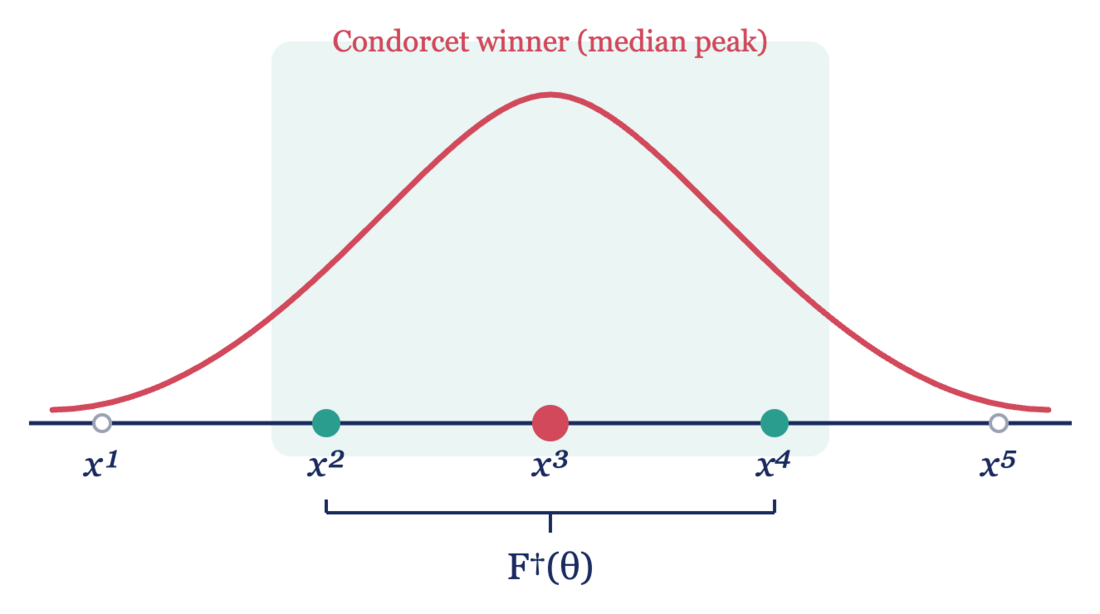 Safe Implementation in Mixed Nash EquilibriumAnand Chopra, Malachy James Gavan, and Antonio PentaJournal of Mathematical Economics, 2026
Safe Implementation (Gavan and Penta, 2025) combines standard implementation with the requirement that the implementing mechanism is such that, if up to k agents deviate from the relevant solution concept, the outcomes that are induced are still ’acceptable’ at every state of the world. In this paper, we study Safe Implementation of social choice correspondences in mixed Nash Equilibrium. We identify a condition, Set-Comonotonicity, which is both necessary and (under mild domain restrictions) almost sufficient for this implementation notion.
@article{chopragavanpenta2026safemixed, status = {published}, title = {Safe Implementation in Mixed Nash Equilibrium}, author = {Chopra, Anand and Gavan, Malachy James and Penta, Antonio}, journal = {Journal of Mathematical Economics}, volume = {122}, number = {1}, year = {2026}, html_label = {Paper} } -
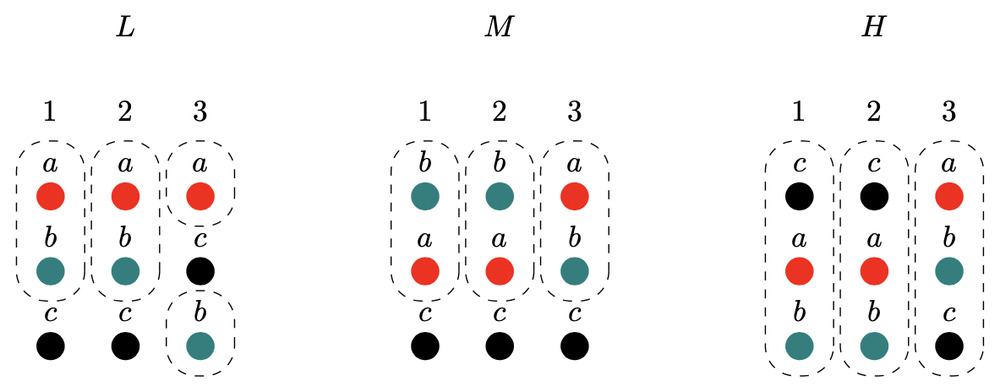 Safe ImplementationMalachy James Gavan and Antonio PentaTheoretical Economics, 2025
Implementation theory is concerned with the existence of mechanisms in which, at each state of the world, all equilibria result in outcomes that are within a given Social Choice Correspondence (SCC). But if agents make mistakes, if their preferences or the solution concept are misspecified, or if the designer is limited in what can be used as punishments, then it may be desirable to insist that also deviations result in ’acceptable’ outcomes. Safe Implementation adds this extra requirement to standard implementation. Our primitives therefore also include an Acceptability Correspondence, which like the SCC maps states of the world to sets of allocations. When the underlying solution concept is Nash Equilibrium, we identify necessary and sufficient conditions (namely, Comonotonicity and Safe No-Veto) that restrict the joint behavior of the SCC and of the Acceptability Correspondence, and that generalize Maskin’s (1977) conditions. In relevant economic applications, these conditions can be quite permissive. But in ’rich’ preference domains, Safe Implementation is impossible, regardless of the solution concept.
@article{gavanpenta2025safe,
  status = {published},
  title = {Safe Implementation},
  author = {Gavan, Malachy James and Penta, Antonio},
  journal = {Theoretical Economics},
  volume = {20},
  number = {4},
  year = {2025},
  html_label = {Paper},
  pdf_label = {WP Version},
}
Working Papers
- Mandates, Trade Structure, and Trade AgreementsMalachy James Gavan and Maria PtashkinaWorking paper
Before trade negotiations begin, governments commit to a mandate, a schedule of concessions contingent on the eventual outcome. We show that the strategic choice of a mandate can prevent an efficient agreement even when both governments would gain from one and can compensate each other freely, and we show when it does: it turns on a single second-order property of the environment, the modularity of aggregate welfare with respect to tariffs. When strictly submodular, the governments’ unilateral claims exceed the available surplus and no efficient agreement can be sustained; when strictly supermodular, an efficient agreement can instead be supported. A general-equilibrium foundation links this property to the structure of trade, where it depends on whether a country pair specialises within or across sectors, a distinction visible in trade data. Bilateral trade data provide illustrative evidence consistent with the mechanism. Holding a pair’s overall balance of trade fixed, specialisation across rather than within sectors is associated with a higher probability of agreement. The mechanism is not special to tariffs, and the same distinction applies to when independently chosen contingent transfers can sustain efficient cooperation in other strategic settings.
@unpublished{gavanptashkina2026mandates, status = {working}, title = {Mandates, Trade Structure, and Trade Agreements}, author = {Gavan, Malachy James and Ptashkina, Maria}, year = {2026}, note = {Working paper}, } -
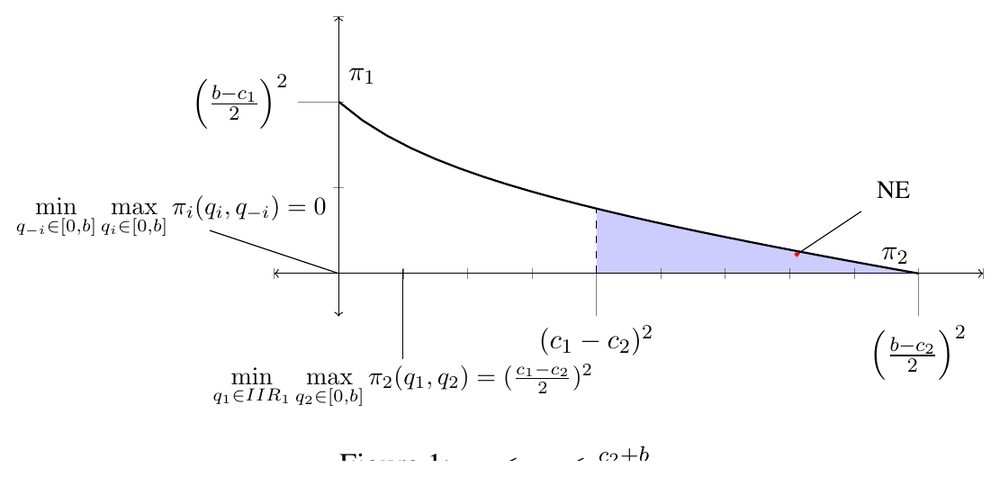 Negotiated Binding AgreementsMalachy James GavanR&R at the Journal of Economic Theory
I study binding agreements over play in a game. I propose a negotiation protocol where, in each round, agents propose actions from the underlying game. The protocol terminates when proposals are confirmed. I study the outcomes of Negotiated Binding Agreements of the negotiation protocol, a refinement of Subgame Perfect Equilibrium. A full characterisation is provided for two-player games, relying on appropriate individual punishments. These individual punishments are used for sufficiency in n-player games and a necessary iterative rationality constraint is introduced. I extend the solution concept to allow cooperative agreements within the negotiation game. Generalisations of the main results hold.
@unpublished{gavan2025negotiated, status = {working}, title = {Negotiated Binding Agreements}, author = {Gavan, Malachy James}, year = {2025}, note = {R&R at the Journal of Economic Theory}, } -
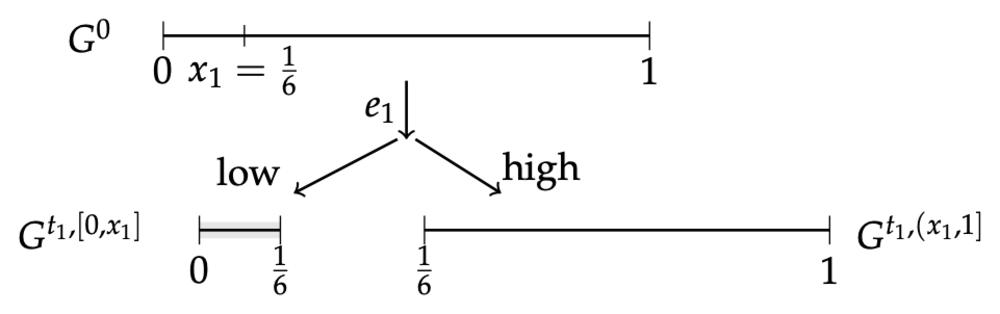 On the Impossibility of Stability-Based Equilibria in Infinite Horizon: An ExampleAlexander Frug and Malachy James GavanR&R at Games and Economic Behavior
We show that stability-based equilibrium refinements may fail to generate renegotiation-proof equilibria in infinite-horizon settings. We study a refinement, called a dynamically consistent partition, that classifies equilibria according to whether they remain immune to future mutually beneficial revisions in every continuation game, allowing for incomplete information. Equilibria that survive this recursive test are interpreted as renegotiation-proof. By contrast, equilibria that lead to a continuation game in which players would jointly prefer to switch to a better equilibrium that survives the test from that point onward are not. We provide a concrete example in which a dynamically consistent partition exists in every finite-horizon truncation and selects a renegotiation-proof equilibrium, but fails to exist in the infinite-horizon limit.
@unpublished{fruggavan2025inconsistency, status = {working}, title = {On the Impossibility of Stability-Based Equilibria in Infinite Horizon: An Example}, author = {Frug, Alexander and Gavan, Malachy James}, year = {2025}, note = {R&R at Games and Economic Behavior}, } - Weak Coalitional Equilibrium: Existence and Overlapping CoalitionsMalachy James GavanWorking paper
I consider Ray and Vohra (1997)’s Coalitional Equilibrium and show the methodological advantage of taking the notion of ’an improvement for a group’ to mean that there is a joint action of the group that induces a strict improvement in utility for all its members. This is opposed to assuming no agent in the group is worse off while one is strictly better off. I show that, when this interpretation is taken, the sufficient conditions for existence of Ray and Vohra (1997)’s Coalitional Equilibrium can be weakened. I do so by showing that the existence of Coalitional Equilibrium is implied by the existence of a Nash Equilibrium of an auxiliary game. Further to this, I show that the proof of existence can be extended to a generalisation of the concept, where groups may overlap but do not necessarily include the grand coalition.
@unpublished{gavan2024weakcoalitional, status = {working}, title = {Weak Coalitional Equilibrium: Existence and Overlapping Coalitions}, author = {Gavan, Malachy James}, year = {2024}, note = {Working paper}, } - Financial Access and Consumption SmoothingAnand Chopra and Malachy James GavanWorking paper
Does improving access to financial institutions facilitate consumption smoothing at different stages of development? Using data for 135 countries, we show that greater financial access raises consumption volatility relative to income volatility in developing countries but lowers it in developed economies. We develop a parsimonious small-open economy model with household heterogeneity in financial access to show that the asymmetric nature of technological shocks experienced by developing and developed economies rationalizes this finding.
@unpublished{chopra2024financial,
  status = {working},
  title = {Financial Access and Consumption Smoothing},
  author = {Chopra, Anand and Gavan, Malachy James},
  year = {2024},
  note = {Working paper},
}